
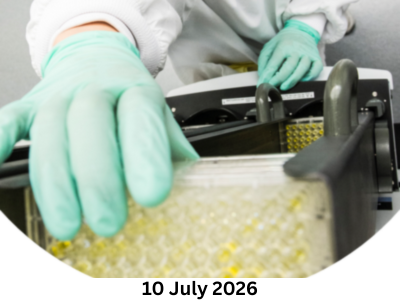
We are delighted to share details of Dr Beate Ehrhardt’s upcoming online lecture on 10 July, hosted by the American Statistical Association – Biopharmaceutical Section, in which she will describe how the spatially aware plate layout tool that she developed can help improve reproducibility, reduce bias, and strengthen downstream statistical analyses.
Title
Spatially Aware Plate Layouts (SAPL): An R Shiny Tool Integrating Experimental Constraints into Randomization for Optimal Plate Designs
Summary
Multi well plates underpin high throughput experimentation across biochemistry, pharmacology, and molecular biology, yet spatial artefacts-such as edge effects and local clustering-can introduce systematic biases that compromise reproducibility and statistical power. Traditional layout strategies, whether manually designed or based on naive randomization, often fail to address these spatial dependencies effectively.
SAPL (Spatially Aware Plate Layouts), a controlled randomization framework that merges rigorous experimental design principles with the spatial structure of common plate formats. In contrast to full randomization, which may inadvertently concentrate critical conditions or controls, SAPL actively enforces spatial balance by managing factors such as control dispersion, edge related susceptibility, and row/column structure. This approach enhances the reliability of normalization procedures and strengthens downstream statistical analyses.
By integrating spatial awareness into the randomization procedure, SAPL helps improve the reproducibility, robustness, and translational value of preclinical data. To facilitate widespread use, SAPL is available as an open access, user friendly R Shiny tool requiring no programming expertise. It reduces the time of generating a 384 well plate from 1 day to 15min. The framework has been rigorously evaluated in collaboration with scientists at AstraZeneca and the Functional Genomics Screening Lab across diverse experimental settings.
Registration
The webinar is free to attend and you may register here (NB the time on the registration page states 11:-00-12:00 EDT, which is 16:00-17:00 BST).