

Inspiring new cross-disciplinary research collaborations
Since launching in September, the Environmental and Climate Resilience themed semester (“themester”), has brought together hundreds of participants from across disciplines to explore some of the pressing challenges of our time.
Hosted by the Centre for Doctoral Training in Statistical Applied Mathematics (SAMBa) and the Institute for Mathematical Innovation (IMI), the programme aims to stimulate new research collaborations, helping position the University of Bath at the forefront of this vital research area.
Workshops and networking events
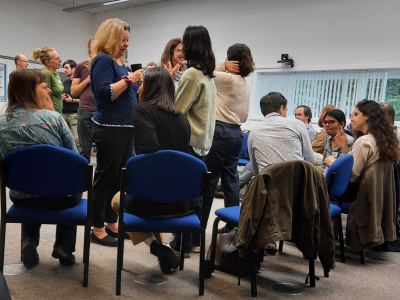
A series of workshops, seminars, film screenings and networking events have attracted participants representing the majority of University departments within the Faculty of Engineering & Design, Faculty of Humanities & Social Sciences, and the Faculty of Science, alongside colleagues from SAMBa, IMI and external organisations.

Highlights have included the Power of 3 workshop, which brought together 26 cross-faculty researchers to develop new environmental resilience collaborations. Project ideas ranged from air quality monitoring and climate adaptation to biodegradable microbots and sustainable infrastructure, with two teams now preparing proposals for follow-on projects and future external funding opportunities:
Proposal 1: Can insights from the social sciences change the way engineering and mathematical models for indoor air quality are formulated?
Proposal 2: Designing an optimal tax policy to take environmental impact into account when choosing materials, technologies and specifications, in both new build and retrofit construction.
Research themes were deliberately interdisciplinary, drawing together mathematics, engineering, environmental science and social science perspectives.
Think differently
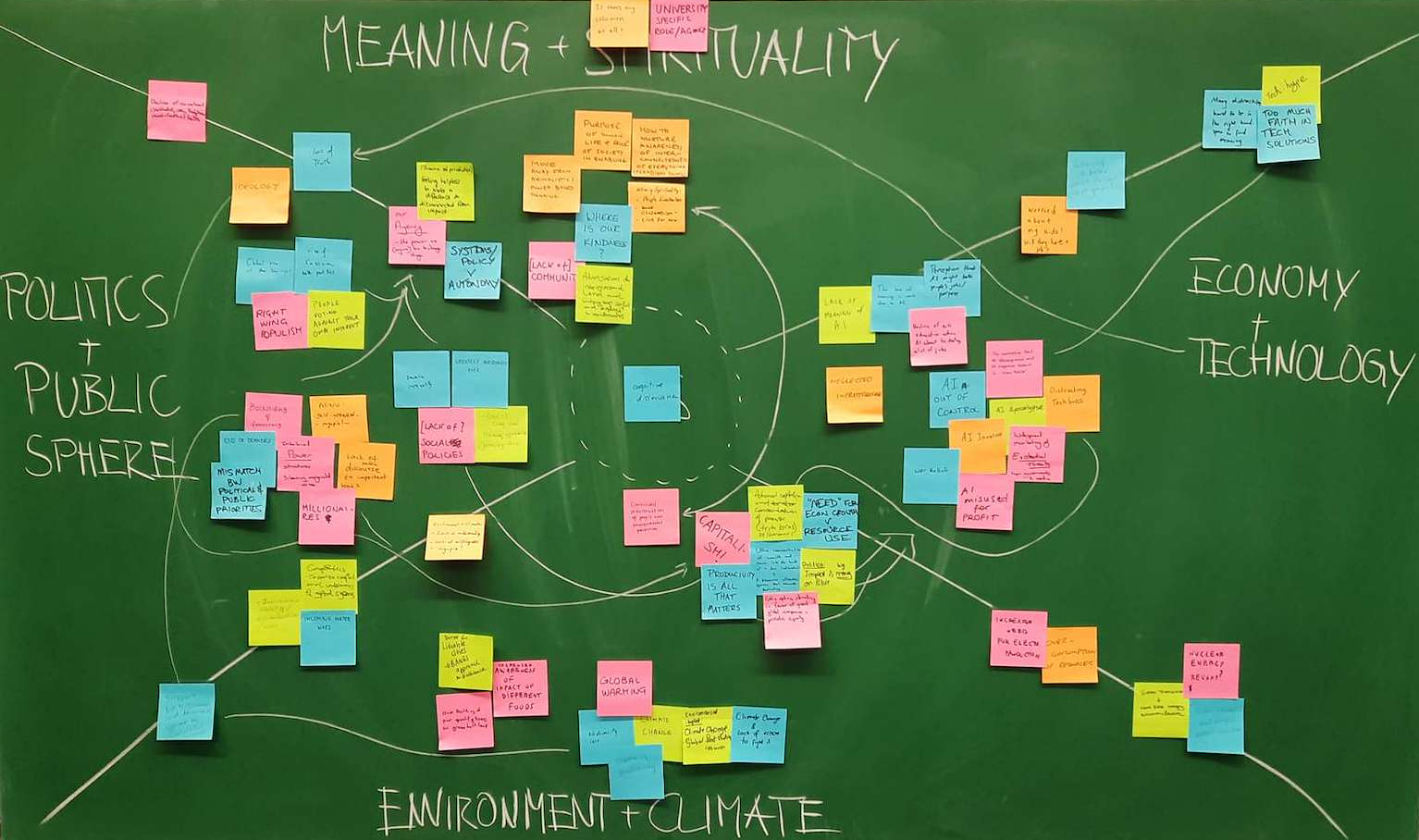
Other events have encouraged participants to think differently about environmental challenges. The Utopian Thinking Workshop used creative, collaborative activities to explore positive visions for the future, generating enthusiasm for ongoing discussions and new ways of incorporating resilience thinking into research and teaching. One participant commented:
“I thought the utopian workshop was quite amazing. The group was incredibly diverse. Discussions went far beyond environmental issues and maths but I think there were common themes around greater community, collaboration and reminding ourselves that we shouldn’t just value productivity and efficiency. There might be ways to build this more generally in the ways we work and our activities.”
Films, fresks and seminars
The semester has also welcomed audiences through a screening of the People’s Emergency Briefing , which attracted around 40 attendees including members of the public. Alongside this, 19 mathematics doctoral researchers participated in a Climate Fresk, using an IPCC-based systems-thinking exercise to map the links between human activities, greenhouse gas emissions, climate processes and societal impacts, while exploring how mathematical modelling can help understand these complex interactions.
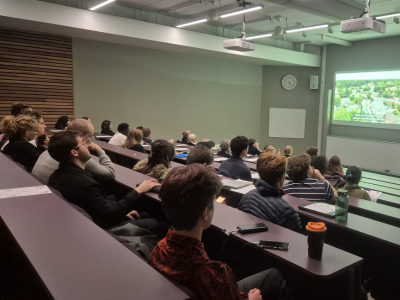
Specialist seminars have further provided opportunities for researchers to exchange ideas and build new connections. Topics have included machine-learning approaches to data assimilation for weather forecasting, probabilistic filtering for complex dynamical systems, and new mathematical perspectives on cloud dynamics and climate processes across multiple scales.
Still to come
Running until February 2027, the themester will continue to showcase how mathematical expertise can contribute to environmental and climate resilience. Upcoming events will explore topics including:
🌡️ Mapping heatwave risk and resilience in a warming world
💦 Finding new approaches for modelling rainfall runoff and flooding
🧮 Exploring how mathematics can support environmental and climate resilience
🌧️ Understanding extreme rainfall and soil-water interactions
🍄 Understanding the emergence of thermotolerant fungal pathogens
With strong attendance, vibrant interdisciplinary engagement and several new collaborations already emerging, the semester is proving to be a valuable catalyst for bringing researchers together to tackle environmental challenges and develop innovative solutions for a more resilient future.